
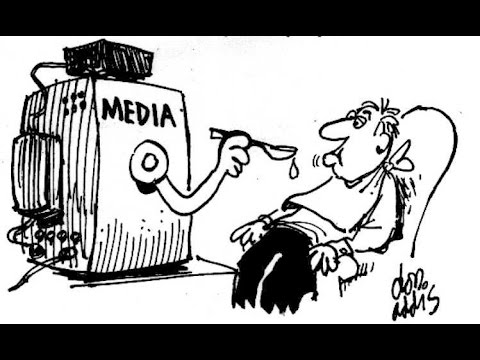
“Don’t watch too much TV, it’s bad for you!”, my mother would always protest as I was doe eyed, lost in a gaze, completely consumed into whatever TV show or commercial airing at the moment. Until recently, I had never taken into account why exactly she has always told me this. In chapter four of Perception and Language Issues in the Mass Media, the author demonstrates how mass media, such as the radio, newspaper, music, the internet, advertisement, and of course television, use factors of perception and various mental processing models to cater to their specific audiences. On account of this, society (the potential audience), is greatly influenced in many ways, but certainly may become dissonant and negatively manipulated by the mass media.
First and foremost, the formation and development of one’s perception is remarkably unique and extremely manipulative. Dependent on various psychological factors such as one’s assumptions, culture and family upbringing, previous experiences, personal mood and motives; perception is strictly exclusive and unique to each individual.

Psychologist and visual physiologist Adelbert Ames Jr., demonstrates that one concept of perception is based on prior assumptions and experiences, with the monocular distorted room. In reference to the illusion, because the observer assumes that the room appears to be an ordinary room, one person in one corner appears to be very large, while the other person in the next corner is very small. The assumption is made because of prior experience with other rooms. As the two people switch corners, one will appear to grow larger as the other shrinks, right before the observer’s eyes.
Cultural background is also a very preeminent influence on one’s perspective. A study conducted with Mexican and American subjects, reported evidence that when shown pictures of common spectator scenes, the subjects seemed to only recognize and distinguish scenes from their own culture rather than an unfamiliar one. The two scenes presented were a baseball game and a bullfighting setting. The images were presented with a binocular-like device, an image seen by one eye, and the other image seen by another, forming a mixture of both scenes.
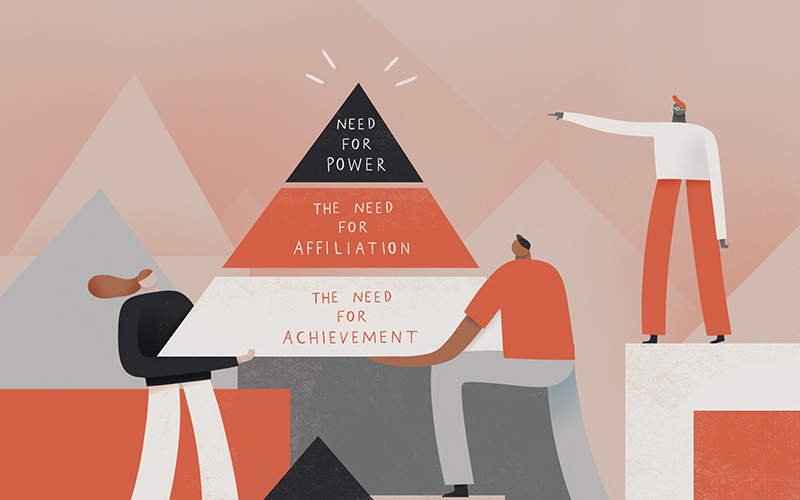
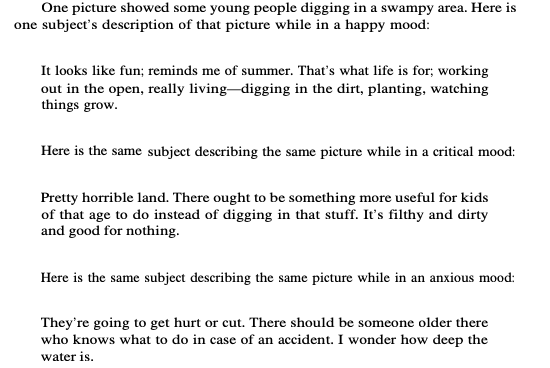
Another concept that affects perception is personal motive and mood. American psychologists McClelland and Atinkson developed theories that, we humans, have natural motivations (needs and wants) to attain personal purpose in life. Those three motivations are the need to achieve, have affiliations, and last but not least, power. Perception is influenced greatly on these paramount qualities because not only will the individual understand presented ideas in accordance with their needs and motives, but they will change their perception and take action in order to achieve their needs and personal motives. A specific personal motive McClelland and Atinkson investigated was hunger. In their experiment the subject groups were deprived of food– one group for 16 hours, another for 4 hours, and the last, 1 hour. The subjects were exposed to image slides, but only faintly visible– if not at all. The concept of the test was to examine the subject’s ability to respond to visual stimulations with different lengths of food deprivation. Results showed that food related responses increased along with the hours of food deprivation. Because of this, a physical motive, such as hunger, influences one’s perception of ideas. Another experiment, subjects were put in different moods before describing a picture. As their mood changed, the picture presented was the same from before, however, the descriptions for the pictures were extraordinarily different according to the mood they were intentionally put in. This further proves that mood also has a vast importance in one’s perception.
Mass communicators combine these various factors of perceptions and mental processing greatly to sustain their audiences. Now the question is, how do they execute these principles with what they broadcast? Quite subliminally and more manipulative than one would think. In Dr. Rimal’s articulately written article, Media Campaigns and Perceptions of Reality, the concept of the false consensus effect is demonstrated. This concept essentially declares that society tends to conform rather easily– more so reluctantly– about a certain idea because they think others will as well. This specifically goes hand in hand with one principle of McClelland’s Motivation Theory– that human beings have the natural motivation to be affiliated, socially accepted, and will go along with what the others (specifically a larger group) wants to do. Because humans are so easy to conform and have the desire to be affiliated and accepted with one another, mass media take the principles in consideration to for example, advertise companies to shop from and air ideas, such as lifestyle norms, they want society to accept and become familiar to.
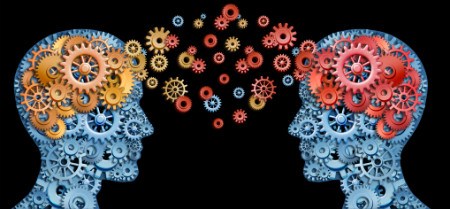
Now of course with various developments and forms of perception, mass media also has the capability to cause their audience (society) to divide– just as easily. Individuals have the tendency to expose themselves to certain communications in mass media only according to what agrees with their existing perception (their culture, experiences, mood, personal motives, etc.). This principle is referred to as selective exposure. This not only causes the audience to become dissonant, but because they choose to only observe ideas according to their preexisting beliefs and way of thinking, this causes a divide in society. Then comes the following principles of selective attention and selective retention. Selective attention is the concept that an individual only pays attention to content that already supports their perception and beliefs. Selective retention is when an individual will only recall information according to their existing perception. Because individuals tend to close their mental horizon (intentionally or not intentionally), this then causes a divide in the society.
In conclusion, I now have a better understanding of why I was told that “watching too much TV is bad” for me. It’s not the act of watching television, but more so the messages and misunderstood messages that mass media broadcasts. With such a diverse and multicultural society, mass media have little to no control over intended perceptions of what they air, whether it be products, ideas, various company advertisements and commercials, and lastly, entertainment, such as shows and movies. Mass media may have control over how explicit and aired content can be, but definitely not general takeaway the audience may have. Along with various mental selective processes that our minds have, society executes these messages they are exposed to (or choose to be exposed to) according to their own needs and wants, and that is how society becomes dissonant and may divide amongst itself.
 Platinum thoughts...